

C Frame vs H Frame Hydraulic Press: Which One Is Right for Your Application?
Choosing the right hydraulic press is important for safe, accurate and efficient production. Two common options are the C Frame Hydraulic Press and the H Frame Hydraulic Press.
Both machines use hydraulic pressure to perform operations such as pressing, forming, bending, punching, straightening and assembly. However, their frame design, strength, working access and suitable applications are different.
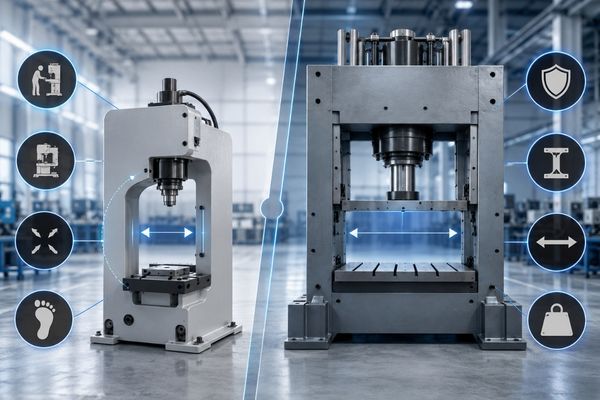
A C Frame Press provides open access from the front and sides. This makes loading, unloading and tool adjustment easier. An H Frame Press has a stronger closed-frame structure that supports heavier and more demanding operations.
The right choice depends on your material, component size, required tonnage, production quantity, tooling and available factory space. This guide explains the major differences so that you can select the right machine for your application.
What Is a C Frame Hydraulic Press?
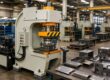
A C Frame Hydraulic Press has a frame shaped like the letter C. It has an open front with open access from the sides.
The machine uses a hydraulic cylinder to move the ram downward. The ram applies controlled force to the tool or component placed on the working table.
Its open-frame design allows operators to load parts, remove finished components and adjust tools more easily. C Frame Presses are commonly used for bending, punching, stamping, blanking, assembly and straightening operations.
- C-shaped machine frame
- Hydraulic cylinder
- Ram or slide
- Working table
- Hydraulic power pack
- Electric motor
- Control panel
- Pressure gauge
- Safety guards
- Punch and die
- Two-hand operating buttons
What Is an H Frame Hydraulic Press?
An H Frame Hydraulic Press has a frame that looks similar to the letter H. It normally includes two strong vertical columns connected by upper and lower cross members.
The working area is positioned between the columns. This structure spreads pressing force across the frame and provides good stability during demanding operations.
H Frame Presses are often used when the job requires higher force, a wider working table or better resistance to frame movement.
Main Parts of an H Frame Press
- Strong vertical columns
- Upper cross beam
- Lower machine bed
- Hydraulic cylinder
- Guided ram or slide
- Adjustable or fixed working table
- Hydraulic power pack
- Control panel
- Safety system
- Custom tools and fixtures
How Do Both Hydraulic Presses Work?
Both machines work using the same basic hydraulic principle.
The electric motor operates a hydraulic pump. The pump sends pressurised oil to the hydraulic cylinder. The cylinder moves the ram and applies force to the component.
After the pressing operation, the hydraulic system returns the ram to its original position.
The pressing cycle may include:
- Fast approach movement
- Slow working movement
- Pressure application
- Holding time
- Pressure release
- Ram return
The main difference is not how hydraulic force is created. The main difference is how the machine frame supports that force.
C Frame vs H Frame Hydraulic Press Comparison
| Comparison Factor | C Frame Hydraulic Press | H Frame Hydraulic Press |
|---|---|---|
| Frame Design | Open C-shaped structure | Strong H-shaped structure |
| Working Access | Open from front and sides | Working area between columns |
| Frame Strength | Suitable for light to medium-duty work | Suitable for medium to heavy-duty work |
| Loading | Easy manual loading | Suitable for large and heavy components |
| Floor Space | Usually more compact | Usually needs more space |
| Tonnage | Commonly used for low to medium tonnage | Commonly selected for higher-force jobs |
| Tool Access | Easy tool adjustment | More controlled tool support |
| Off-Centre Load | Should be carefully controlled | Better suited to balanced heavy loads |
| Typical Use | Punching, bending and assembly | Straightening, forming and heavy pressing |
| Cost | May be lower for basic applications | May cost more due to stronger construction |
| Automation | Easy to add for small components | Suitable for larger automated systems |
| Best For | Flexible production and easy access | Heavy-duty and stable pressing |
Difference in Frame Design
The frame is the biggest difference between the two machines.
C Frame Design
A C Frame Press has an open throat. The operator can approach the table from the front and sides.
This design is helpful when:
- Parts must be loaded manually
- The component is long or wide
- Tools need frequent adjustment
- The operator requires clear working access
- Material enters from one side and exits from another
The open design is convenient, but heavy or unbalanced pressure can place more stress on the frame.
H Frame Design
An H Frame Press has two side columns that support the upper and lower parts of the machine.
This structure creates a stronger pressing area. It helps the machine handle high force with better stability.
It is useful when:
- The operation requires high tonnage
- The component is large or heavy
- The tool requires strong support
- Pressing force must remain centred
- The machine runs demanding production cycles
Tonnage and Pressing Force
Tonnage is the maximum force a hydraulic press can apply.
The required tonnage depends on:
- Material type
- Material strength
- Material thickness
- Operation type
- Forming depth
- Tool design
- Contact area
- Component shape
A C Frame Press may be suitable for many low and medium-tonnage operations. Presstech’s published C Frame range includes different models from 10 tons to 300 tons. The available table size, stroke, motor power and working speed change according to the selected model.
An H Frame Press is often selected when the job needs greater force or stronger structural support. However, machine selection should not be based only on tonnage.
Do Not Select Tonnage by Guesswork
Avoid these common methods:
- Copying another factory’s machine capacity
- Choosing the largest machine available
- Selecting only by material thickness
- Buying only according to price
- Ignoring the tool contact area
- Ignoring future production nee
Share your drawing, sample, material details and tool information with the manufacturer before confirming capacity.
Frame Rigidity and Deflection
Deflection means a small amount of movement or bending in the machine frame when high force is applied.
Every press experiences some amount of stress. However, excessive movement can affect:
- Part dimensions
- Tool alignment
- Bend angle
- Surface finish
- Product consistency
- Tool life
C Frame Rigidity
The open structure of a C Frame Press provides better access, but it may have more frame opening under demanding loads.
A properly designed C Frame Press can still provide accurate results when:
- The load is properly centred
- The machine has enough capacity
- The frame is correctly designed
- The tool is properly mounted
- The operation stays within machine limits
H Frame Rigidity
The two-column structure of an H Frame Press generally provides stronger support around the working area.
This makes it suitable for:
- Heavy pressing
- Large tools
- Long working cycles
- Straightening thick components
- High-force assembly work
- Jobs requiring better structural stability
Working Access and Material Loading
Working access affects how quickly and safely components can be loaded.
Access on a C Frame Press
The open front and sides provide good access to the working table.
This helps when:
- The operator loads parts by hand
- Material is long
- Components need side entry
- Tools are changed frequently
- Finished parts must be removed quickly
The C Frame design is useful for smaller parts and flexible production.
Access on an H Frame Press
The side columns limit some access, but the wide front opening can support large components.
Heavy components may be loaded using:
- Cranes
- Hoists
- Roller tables
- Conveyors
- Forklifts
- Robotic handling systems
An H Frame Press may be better when component weight is more important than side access.
Table Size and Component Dimensions
The working table must support the complete tool and component.
Before selecting a machine, check:
- Tool length
- Tool width
- Component dimensions
- Mounting-hole position
- Clamp space
- T-slot requirements
- Scrap-removal space
- Loading direction
- Finished-part removal
- Sensor or feeder space
A C Frame Press may be suitable for compact tooling and parts that need side access.
An H Frame Press may provide a wider and stronger table for large tools, fixtures and heavy components.
The machine-selection format should include application, material, tonnage, table size, stroke, daylight, speed, controls, safety, tooling and production needs.
Stroke and Daylight Requirements
Stroke is the distance travelled by the ram.
Daylight is the open distance between the ram and working table when the ram is in its upper position.
These dimensions determine whether the tool and component can fit inside the machine.
Check the Following Measurements
- Total tool height
- Raw component height
- Finished component height
- Required pressing depth
- Part-loading clearance
- Part-removal clearance
- Fixture height
- Ejector height
A machine may have enough tonnage but still be unsuitable if its stroke or daylight is too small.
Both C Frame and H Frame Presses can be designed with different stroke and daylight options. The correct dimensions should be based on the complete tool layout.
Accuracy and Repeatability
Accuracy means producing the component at the required measurement.
Repeatability means producing the same result in every cycle.
Both C Frame and H Frame Presses can provide good accuracy when they have:
- Proper frame design
- Accurate ram guidance
- Suitable tooling
- Controlled hydraulic pressure
- Adjustable stroke
- PLC control
- Correct load position
- Regular maintenance
An H Frame Press may be preferred for demanding operations where frame stability is very important.
A C Frame Press may provide good results for punching, bending and assembly when the load is centred and the machine is correctly selected.
Production Speed
Machine speed affects the number of parts that can be produced in one shift.
A hydraulic press may have three main speeds:
- Approach speed
- Pressing speed
- Return speed
The machine must also allow enough time for:
- Part loading
- Tool positioning
- Actual pressing
- Holding pressure
- Ram return
- Part unloading
- Quality checking
Which Machine Is Faster?
Neither frame type is always faster.
Production speed depends on:
- Hydraulic system design
- Cylinder size
- Pump capacity
- Stroke length
- Loading method
- Tool design
- Automation level
- Operator skill
A C Frame Press may support fast manual loading because of its open design.
An H Frame Press may support high-volume production when connected to automatic handling equipment.
Why Choose Presstech Machine India?
Presstech Machine India Pvt. Ltd. provides hydraulic press solutions for different bending, punching, stamping, forming and assembly requirements.
Its C Frame Hydraulic Press range includes different capacities, table sizes, strokes, motor powers and operating speeds. Manual, semi-automatic and automatic options can be planned according to the required production process.
Customers should share their:
- Component drawing
- Material details
- Material thickness
- Tool dimensions
- Required production quantity
- Preferred loading method
- Factory-space details
Conclusion
A C Frame Hydraulic Press and an H Frame Hydraulic Press both provide reliable pressing solutions, but they are designed for different production needs.
A C Frame Press is a practical choice when you need easy access, compact installation, frequent tool changes and flexible production. It is commonly used for punching, bending, stamping and assembly work.
An H Frame Press is better suited to jobs that require strong frame support, heavy components, larger tools and higher pressing force. It is commonly selected for straightening, heavy forming and demanding assembly operations.
Do not choose only by machine price or tonnage. Check the material, operation, tool size, frame strength, stroke, daylight, production quantity and safety requirements.
Sharing complete technical details with an experienced hydraulic press manufacturer will help you select a machine that improves accuracy, safety and long-term production performance.
Frequently Asked Questions
A C Frame Press has an open structure for easy working access, while an H Frame Press has a stronger two-column structure for heavy and stable pressing.
A C Frame Hydraulic Press is commonly selected for punching because its open design makes part loading and tool adjustment easier.
An H Frame Hydraulic Press is generally better for heavy operations because its frame provides stronger support around the pressing area
C Frame Presses are available in different capacities, but the suitability depends on frame design, load position, tooling and the actual operation.
A C Frame Hydraulic Press normally has a more compact design and may need less floor space than a comparable H Frame Press.
Yes. C Frame and H Frame Presses can be connected with PLC controls, feeders, sensors, conveyors and robotic loading systems.
A C Frame Hydraulic Press provides better side access because of its open-frame design.
An H Frame Press is often preferred for heavy straightening because of its stronger structure and stable working area.