
How to Choose the Right C Frame Hydraulic Press for Your Application
Choosing a C Frame Hydraulic Press is not only about buying the machine with the highest tonnage. A larger machine may cost more, use more power and take up more space. A smaller machine may fail to complete the job safely or accurately.
The right press should match your actual product, material, tool and production target. It should provide enough force without placing unnecessary load on the machine or workpiece.
A C Frame Hydraulic Press has an open front and open sides. This design gives the operator easier access to the working table. It is commonly used for bending, punching, stamping, blanking, straightening and assembly work.
This guide will help you compare the main factors and avoid common mistakes while selecting machine.
What Is a C Frame Hydraulic Press?
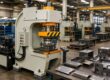
A C Frame Hydraulic Press is an industrial machine with a frame shaped like the letter “C.” It uses hydraulic pressure to move a ram or slide downward and apply force to a workpiece.
The open frame gives access from the front and both sides. This makes it easier to load parts, position tools and handle components with unusual shapes. Presstech lists C Frame presses for operations such as bending, punching, stamping and assembly.
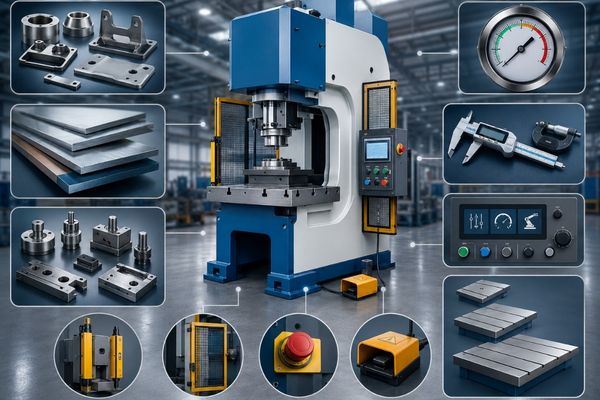
The main parts of a C Frame Hydraulic Press may include:
- Machine frame
- Hydraulic cylinder
- Ram or slide
- Working table
- Hydraulic power pack
- Electric motor
- Control panel
- Pressure gauge
- Safety guards
- Two-hand operating controls
- Punches, dies or custom tools
Why Is Correct Machine Selection Important?
The wrong machine can create several production problems.
A press with low capacity may not produce the required force. This can result in incomplete forming, poor part quality or repeated machine overload.
A press with an incorrect bed size may not hold the tool or workpiece properly. A short stroke may prevent the machine from completing the operation. A slow machine may also reduce daily output.
Correct selection can help you:
- Machine frame
- Hydraulic cylinder
- Ram or slide
- Working table
- Hydraulic power pack
- Electric motor
- Control panel
- Pressure gauge
- Safety guards
- Two-hand operating controls
- Punches, dies or custom tools
Understand the Work You Need to Perform
Start by clearly defining the application. Do not select a press only by looking at a brochure or another factory’s machine.
Ask these questions:
- What operation will the press perform?
- Which material will be used?
- What is the material thickness?
- What are the part dimensions?
- How many parts are required each day?
- Will one tool or several tools be used?
- Is manual loading suitable?
- Does the job require automatic feeding?
- What level of accuracy is required?
A press for simple bearing fitting may be different from a press used for sheet-metal punching. A machine for occasional repair work will also be different from a machine running continuously in a production line.
Select the Correct Press Tonnage
Tonnage means the maximum force that a hydraulic press can apply. It is one of the most important selection factors.
The required tonnage depends on:
- Material type
- Material strength
- Sheet or component thickness
- Length of the bend or cut
- Tool design
- Part shape
- Type of operation
- Required forming depth
- Number of operations in one cycle
For example, punching thick steel normally needs more force than pressing a small bearing. A long bend may also require more force than a short bend.
Presstech’s published C Frame model range includes machines from 10 tons to 300 tons. Available machine details vary by model, including table size, slide size, stroke, daylight, motor power and working speed.
Check the Material Type and Thickness
- Different materials behave differently under pressure.Common materials used with hydraulic presses include:
- Mild steel
- Stainless steel
- Aluminium
- Copper
- Brass
- Galvanised steel
- Engineering components
- Selected non-metallic materials
- Stainless steel may require different force than mild steel of the same thickness. Aluminium is lighter, but it may need careful pressure control to prevent marks or deformation.Before selecting the press, provide the manufacturer with:
- Exact material name
- Material grade
- Thickness
- Width and length
- Tensile strength, when available
- Finished component drawing
- Surface-finish requirement
Giving complete material details helps the manufacturer recommend a more suitable press and tool setup.
Check the Bed and Table Size
The working table must be large enough for the tool and workpiece. It must also leave enough space for safe loading, unloading and adjustment.
Check these dimensions:
- Tool length
- Tool width
- Component size
- Required support area
- Bolt-hole position
- T-slot requirement
- Space for clamps
- Space for scrap removal
- Space for sensors or feeders
A table that is too small may not support the tool correctly. A very large table may increase the overall machine size and cost without providing a real benefit.
Presstech’s listed models include different table sizes, starting from 500 × 400 mm and increasing for larger-capacity machines.
Ask for a Tool Layout
Before confirming the machine, ask the manufacturer to prepare a basic tool and table layout. The drawing should show:
- Tool position
- Tool centre line
- Mounting points
- Workpiece movement
- Operator position
- Loading direction
- Finished-part removal
This simple check can prevent major fitting problems after machine delivery.
Understand Stroke Length
Stroke length is the total distance travelled by the ram or slide.
The required stroke depends on:
- Height of the component
- Height of the punch and die
- Depth of pressing
- Space needed to load the part
- Space required to remove the finished component
- Use of ejectors or fixtures
A stroke that is too short may not complete the job. An unnecessarily long stroke may increase cycle time.
Presstech’s C Frame product range lists different stroke lengths across its models, from 250 mm on smaller listed models to 700 mm on larger ones.
How to Check Stroke Requirement
Add together:
- Tool closing movement
- Required forming or pressing depth
- Part-loading clearance
- Part-removal clearance
- A practical adjustment allowance
Share the complete tool height with the machine manufacturer before finalising the stroke.
Check Daylight and Shut Height
Daylight is the open distance between the ram and table when the ram is in its upper position.
Shut height is the available space when the ram is at the lower working position. These measurements are important for fitting the tool and loading the component.
You should check:
- Maximum tool height
- Minimum tool height
- Raw-part height
- Finished-part height
- Loading clearance
- Fixture height
- Ejector space
A press may have enough tonnage but still be unsuitable if the tool cannot fit inside the working area.
Choose the Right Operating Speed
A hydraulic press may have three main speeds:
- Approach speed
- Working or pressing speed
- Return speed
Approach Speed
This is the speed at which the ram moves towards the workpiece before pressing begins.
A faster approach can reduce idle time, but the machine must slow down before touching the component.
Working Speed
This is the controlled speed used during the actual pressing operation.
A slower and stable working speed may be important for accurate forming, assembly and deep pressing.
Return Speed
This is the speed at which the ram returns to its starting position after the operation.
Higher return speed can reduce the total cycle time, but it must remain safe for the tool and operator.
Calculate Production Need
Use this simple planning method:
Available production time ÷ required daily quantity = maximum cycle time per part
Also include:
- Part-loading time
- Machine approach time
- Actual pressing time
- Holding time
- Return time
- Part-unloading time
- Inspection time
Do not compare machines only by maximum speed. A stable and repeatable production cycle is more important than a high speed shown in a catalogue.
Select Manual, Semi-Automatic or Automatic Operation
C Frame Hydraulic Presses can be supplied with different levels of control. Presstech lists manual, semi-automatic and fully automatic operation options.
Manual Operation
Manual operation may suit:
- Repair workshops
- Low production quantities
- Tool trials
- Simple assembly jobs
- Jobs with frequent part changes
The operator loads the component and starts each cycle.
Semi-Automatic Operation
Semi-automatic operation may suit:
- Medium production quantities
- Repeated operations
- Standard part sizes
- Businesses that need better cycle consistency
The operator loads the part, while the press follows a programmed cycle.
Fully Automatic Operation
Semi-automatic operation may suit:
- High-volume production
- Parts with a fixed design
- Integration with feeders or robots
- Production lines with strict cycle targets
- Applications needing low operator handling
Automation can improve output, but it also needs better planning, tooling, sensors and maintenance support.
| Operation Type | Best Suited For | Main Advantage |
|---|---|---|
| Manual | Low-volume and frequently changing jobs | Simple operation |
| Semi-Automatic | Medium-volume production | Better cycle control |
| Fully Automatic | High-volume production | Faster and consistent output |
C Frame Hydraulic Press Selection Table
| Selection Factor | What You Should Check |
|---|---|
| Application | Bending, punching, stamping, assembly or straightening |
| Material | Material type, grade, strength and thickness |
| Tonnage | Force required for the actual operation |
| Table Size | Tool and component dimensions |
| Stroke | Required ram travel |
| Daylight | Tool and loading clearance |
| Speed | Required production cycle |
| Controls | Manual, semi-automatic, PLC or HMI controls |
| Safety | Safety guards, emergency stop and two-hand controls |
| Tooling | Tool size, weight and mounting requirements |
| Production | Current daily output and future production requirements |
| Service | Installation, operator training and spare-parts support |
Step-by-Step Buying Checklist
Before ordering a C Frame Hydraulic Press, complete this checklist:
- Prepare the finished-part drawing.
- Confirm the material type and thickness.
- Define the operation clearly.
- Calculate or verify the required force.
- Measure the tool and component.
- Check the required table size.
- Confirm stroke and daylight.
- Decide the required cycle time.
- Select manual, semi-automatic or automatic operation.
- Confirm the control system.
- Review all safety features.
- Check factory power and floor space.
- Conduct a sample trial where possible.
- Review the written technical offer.
- Confirm installation, training and warranty support.
Questions to Ask a C Frame Hydraulic Press Manufacturer
Before selecting a manufacturer, ask
- Have you supplied a machine for a similar application?
- How did you calculate the required tonnage?
- Can you conduct a trial with our component?
- Can the bed size and stroke be customised?
- Which hydraulic and electrical brands will be used?
- Which safety systems are included?
- Will you provide installation and training?
- Which documents will be supplied?
- How quickly are spare parts available?
- What is covered under the warranty?
- Can the machine be upgraded with automation later?
- What preventive maintenance is required?
Clear answers help you compare suppliers based on technical value, not only price.
Why Choose Presstech Machine India?
Presstech Machine India Pvt. Ltd. offers C Frame Hydraulic Press machines for bending, punching, stamping, forming and assembly applications. Its listed range includes models from 10 tons to 300 tons with different table sizes, strokes, motor capacities and operating speeds.
The company also offers options for manual, semi-automatic and automatic operation. Machine features such as tonnage, bed size, stroke, speed and control systems can be planned according to specific production requirements.
Customers should share their component drawing, material details, tool dimensions and production quantity to receive a suitable technical recommendation.
Conclusion
Choosing the right C Frame Hydraulic Press starts with understanding your application. Tonnage is important, but it is not the only factor.
You must also check the material, tool dimensions, table size, stroke, daylight, working speed, controls, safety and production volume. Service support and spare-part availability are equally important for long-term machine performance.
Do not make the final choice based only on price or tonnage. Share complete technical details with the manufacturer, request a written specification and conduct a sample trial where possible. This will help you choose a machine that is safe, accurate and suitable for your present and future production needs.
Frequently Asked Questions
Choose the press according to your application, material, required force, tool size, stroke, daylight, speed, controls and daily production quantity.
The required tonnage depends on the material strength, thickness, operation, tool design and forming area. Ask the manufacturer to verify it using your drawing and sample.
Its open-front and open-side design provides easier access for loading components, changing tools and handling parts.
Yes. A properly selected C Frame Hydraulic Press can be used for punching, blanking, stamping and similar sheet-metal operations.
Yes. Tonnage, table size, stroke, daylight, speed, controls, tooling and automation can be customised according to the application.
Stroke is the distance travelled by the ram. Daylight is the open space between the ram and working table when the ram is at the top.
A manual press may suit small batches and changing jobs. An automatic press may be better for high-volume and repeated production.
Important features include an emergency stop, guards, two-hand controls, pressure protection, electrical interlocks and suitable operator protection.