


Top-Quality Section Bending Roll Manufacturer
If your metal fabrication business struggles with shaping tough steel profiles, partnering with Presstech Machine India Pvt. Ltd., a trusted Section Bending Roll Manufacturer, is the ultimate solution. A section bending roll machine is a heavy-duty industrial tool used specifically to curve and bend solid metal sections like pipes, solid bars, and thick steel angles into perfect circles or arcs. Without this machine, bending thick metal by hand or with weak tools takes too much time, ruins expensive materials, and creates unsafe working conditions.
In the modern metal fabrication and construction industry, getting the exact curved shape is extremely important. If a bent steel beam or pipe is even slightly off-angle, it will not fit into a building or a machine frame properly during welding. By using a specialized section bending roll, factories can curve metal smoothly and accurately without damaging its structural strength. This guarantees a safe, perfect fit every single time, saving massive amounts of money, reducing raw material waste, and keeping your factory production moving fast.
What is Section Bending Roll?
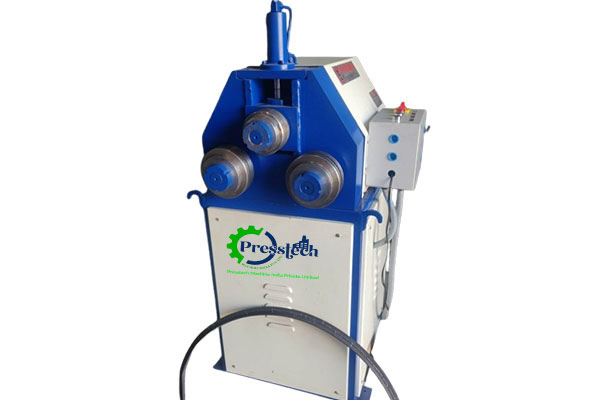
A section bending roll is a powerful industrial machine designed to take straight pieces of heavy metal and slowly roll them into smooth, curved shapes. Think of how a baker uses a rolling pin to shape dough, but instead of flattening it, this machine curves solid steel! The machine uses three very strong, hardened steel wheels (called rollers) arranged in a triangle. By passing the metal back and forth through these tight rollers, the machine slowly bends the metal into the required shape.
This machine is specifically built to handle heavy “sections” of metal. This includes round pipes, square tubes, flat metal bars, T-bars, and L-shaped steel angles. Real-world examples of products made using a section bending roll include the massive curved steel beams found in stadium roofs, circular metal staircases in homes, curved exhaust pipes, and the strong metal support rings used to build large liquid storage tanks.
How Section Bending Roll Works
The process of bending straight steel into a perfect circle is highly controlled. Here is how the machine works:
-
Material placement: The operator safely feeds the straight metal pipe or steel angle between the top and bottom rollers of the machine.
-
Roller adjustment: The top or bottom rollers are tightened mechanically or hydraulically to apply heavy pressure directly against the solid metal.
-
Bending process: The powerful motor turns the heavy rollers, gripping the metal and pulling it back and forth continuously through the machine.
-
Shape formation: As the roller pressure slowly increases with each pass, the straight metal safely stretches and forms into a smooth, curved arc.
- Final output: Once the exact curved angle is reached, the machine releases the pressure, and the perfectly bent metal section is removed for welding or assembly.
Key Features of Section Bending Roll
- Built with a heavy welded steel frame to handle intense daily factory vibrations.
- Guarantees perfectly identical and accurate curved angles for easy metal assembly.
- Easily adjusts roller wheels to fit round pipes, square tubes, and solid flat bars.
- Features a simple, user-friendly control panel for safe and easy daily operation.
- Forged from thick, hardened steel to bend tough metals without breaking or wearing down.
- Engineered with premium motors and bearings for reliable and low-maintenance servicing.
Applications of Section Bending Roll
FAQs on Section Bending Roll
A manufacturer designs, engineers, and builds heavy-duty industrial machines equipped with three powerful steel rollers. These machines are specifically built to help metal fabrication factories bend straight, thick metal pipes, angles, and bars into perfect curves or full circles.
The machine works by placing a straight piece of metal between three strong rollers. The powerful motor pulls the metal back and forth while the middle roller pushes down with immense pressure. This slow, steady pressure safely stretches the solid metal into a perfect curve.
This heavy-duty machine is highly versatile and can bend almost any industrial metal. The most common materials used are mild steel, stainless steel, aluminum tubes, copper, and brass. It easily bends round pipes, square tubes, solid bars, and structural I-beams.
A manual machine uses a hand-cranked wheel to lower the top roller and apply pressure, making it best for thin metals and small jobs. A hydraulic machine uses powerful fluid cylinders to push the rollers down with massive force, allowing operators to bend very thick, solid steel beams with the push of a button.
You need to know the maximum thickness and the hardest material your factory plans to bend. A manufacturer will look at your thickest steel pipe or angle and recommend the correct roller diameter and motor horsepower so the machine does not struggle or break under pressure
The exact cost depends entirely on the size, bending power, and automation of the machine. A small, manual hand-cranked machine will cost much less than a massive, fully automatic CNC hydraulic machine. You should contact a manufacturer directly with your required metal sizes for an exact price quote.